
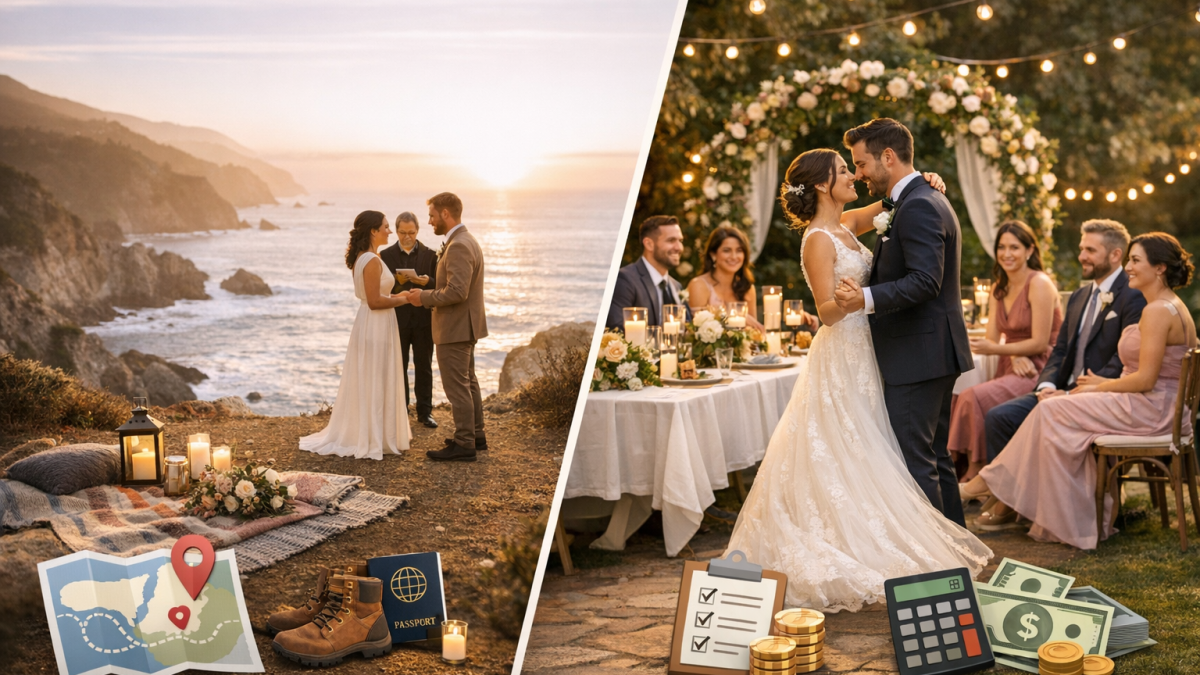
Somewhere along the way, “small wedding” stopped being a compromise and started being a real, first-choice option. I hear it constantly from couples now: they don’t want a 150-person production, they don’t want to spend a year managing seating charts and second cousins, and they’re not sure if that makes them eloping or having a micro-wedding — or if there’s even a difference.
There is a difference, and it matters, because the two paths lead to very different planning timelines, budgets, and emotional conversations with family. Let’s sort it out properly so you can pick the version that actually fits you, not just the one with the prettiest photos on your feed.
First, the Actual Definitions
These terms get used interchangeably online, which causes most of the confusion. Here’s how I’d draw the lines:
- Elopement: Historically meant running off in secret, but today it simply means a wedding built around just the two of you — sometimes with an officiant and a photographer, sometimes with a couple of witnesses, rarely with a guest list beyond immediate family (if that). No reception in the traditional sense, though many couples add a dinner afterward.
- Micro-wedding: A full wedding — ceremony, reception, dinner, maybe dancing — with a deliberately small guest list, usually under 50 people, sometimes as tight as 10-15. It has the shape and rituals of a “real” wedding, just scaled down.
- Minimony: A term that popped up during 2020 and stuck around — a small, immediate-family ceremony now, often with plans for a larger celebration later. Worth knowing the word exists, but it’s really just a micro-wedding with a promise attached.
The distinction that actually matters for your planning: an elopement is designed around simplicity and intimacy. A micro-wedding is designed around full wedding experience at small scale. One is not a lesser version of the other — they’re different events with different goals.
The Cost Comparison Nobody Explains Correctly
Here’s the myth: “fewer guests means a fraction of the cost.” Here’s the reality: a lot of wedding costs don’t scale down linearly with guest count, because they’re not priced per-person to begin with.
| Cost category | Scales down with guest count? |
|---|---|
| Catering, cake, favors, rentals per seat | Yes — this is where you’ll see real savings |
| Photography/videography | No — most photographers charge by hours covered, not headcount |
| Officiant | No — flat fee regardless of guest count |
| Attire, hair, makeup | No — same cost whether 5 or 200 are watching |
| Venue minimums | Often no — many venues have a food-and-beverage minimum regardless of headcount |
| Florals for ceremony/decor (not centerpieces) | No — an arch or arrangement costs the same for 10 guests or 150 |
This is why couples are sometimes surprised that their “tiny” wedding still ran up a real bill. A true elopement — courthouse or scenic spot, photographer, no reception — genuinely can cost a few thousand dollars total. A micro-wedding with a venue, catering, florals, and a photographer can still land in the $15,000–$30,000+ range, because you’re paying full price for most vendors and simply serving fewer plates. Small doesn’t automatically mean cheap. It means you get to choose exactly what you’re paying for — which is valuable in its own right, just not the same thing as automatic savings.
Questions That Actually Help You Decide
Skip the Pinterest boards for a minute and answer these honestly, together:
1. Do you want to say vows in front of people, or just each other?
This is the real dividing line. If the idea of your closest 30 people watching you cry through your vows sounds meaningful, you want a micro-wedding. If it sounds like pressure, you want an elopement.
2. Is there a parent or grandparent whose absence you’d genuinely regret?
Be specific. Not “people would be sad” — but is there someone whose absence from your actual ceremony would leave a lasting regret? If yes for even a couple of people, a minimony or small micro-wedding usually serves you better than a pure elopement.
3. Do you want a party, or do you want a moment?
Elopements are moments. Micro-weddings can absolutely include a party — dancing, toasts, a full dinner — just with a smaller guest list. If “we still want to dance to our song surrounded by people we love” is non-negotiable, you’re planning a micro-wedding, not an elopement.
4. How do you feel about a second celebration later?
Many couples elope or hold a minimony, then throw a larger party months later — sometimes with no ceremony at all, just food and dancing. This isn’t a downgrade or an afterthought; it’s a legitimate way to get both an intimate legal/spiritual moment and a bigger celebration without merging the two events’ very different logistics.
Logistics That Trip People Up
For elopements:
- Marriage license timing varies by state and country — some require waiting periods, some require both parties to appear in person, and requirements differ sharply if you’re eloping somewhere other than your home state. Confirm this months out, not the week before.
- Witnesses may be legally required. Many jurisdictions require one or two witnesses present at the ceremony. Check before you assume “just the two of us” is legally possible where you’re going.
- Permits for scenic/public locations are often required for photography or ceremonies at national parks, beaches, and other public land — and they can take weeks to process.
For micro-weddings:
- Guest list cuts are harder than they sound. Going from 150 to 30 means real conversations and real hurt feelings if you’re not careful. Decide your cutoff logic early (immediate family only, no plus-ones, no coworkers) and apply it consistently so no one feels singled out.
- Venue minimums don’t always drop. Ask directly whether the venue has a food-and-beverage or rental minimum that applies regardless of your headcount — this is where “micro-wedding” budgets sometimes balloon unexpectedly.
- Vendors may not have a “small wedding” package. Ask directly rather than assuming a discount exists. Some vendors do offer reduced packages for shorter timelines or fewer deliverables; many don’t, and it’s fine to ask plainly.
The Family Conversation You Can’t Skip
Whichever path you choose, tell the people who’d expect to be there — before they hear about it secondhand. A short, warm, direct conversation (“we’ve decided we want something small and intimate, and this is why it matters to us”) goes a long way further than an Instagram announcement. If you’re planning a larger celebration later, say so now; it genuinely softens the disappointment for people who might otherwise feel cut out.
The Bottom Line
Neither option is more “real” than the other, and neither is automatically the budget-friendly choice — that depends entirely on what you build into it. The right call comes down to one honest question: do you want the day to be about a private moment between the two of you, or a small, full celebration with the people who matter most? Answer that first, and the venue, vendor, and guest list decisions get a lot easier to make.